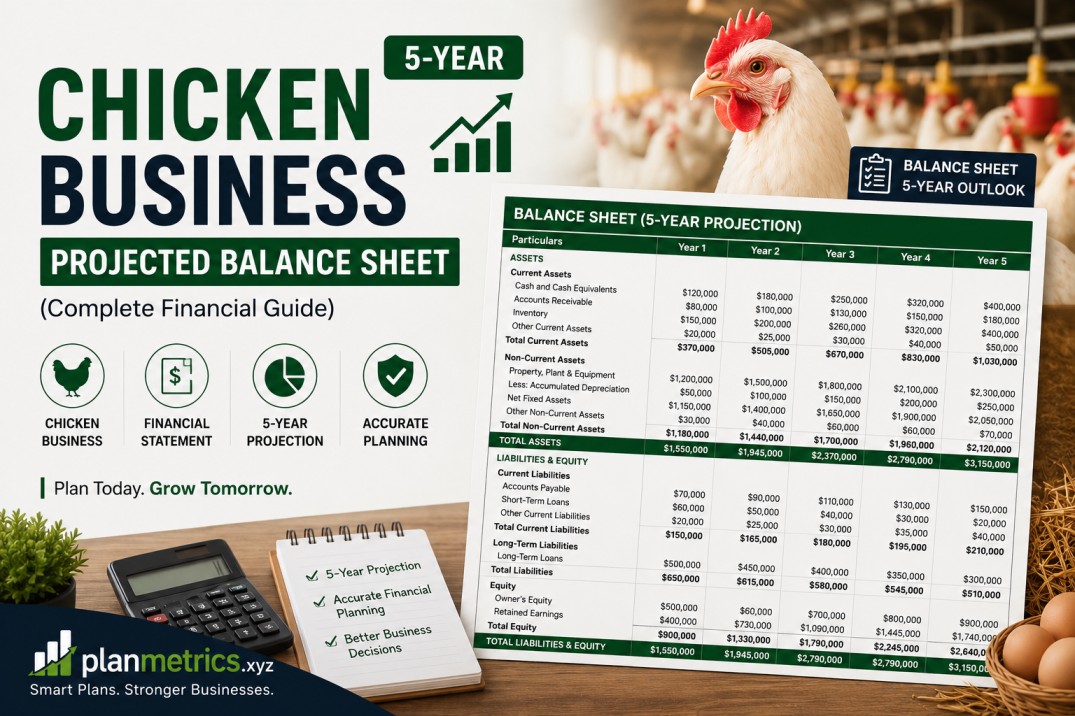
When I first got seriously involved in poultry farming, someone handed me a profit and loss statement and said, “Here’s how the business is doing.” I nodded like I understood. But what nobody showed me — and what I had to learn the hard way — was the balance sheet.
The P&L tells you if you made money. The cash flow tells you if you have money. But the balance sheet tells you what your business is actually worth at any given moment. It’s the full financial portrait — assets, liabilities, and equity all in one place.
For a chicken farm planning across 5 years, the balance sheet is where the big picture comes into focus. Let me walk you through every line of a real 5-year projected balance sheet, using actual numbers, so you know exactly what’s happening and why it matters.
What Is a Projected Balance Sheet?
A balance sheet follows one golden rule — always:
Total Assets = Total Liabilities + Owner’s Equity
That equation must balance perfectly every single year. If it doesn’t, something is wrong in your numbers.
Here’s what each section means:
- Assets — Everything the business owns (land, equipment, inventory, cash)
- Liabilities — Everything the business owes (loans, outstanding bills)
- Owner’s Equity — What’s left for the owner after all debts are paid
For a chicken farm, the balance sheet tracks how your investment grows from a debt-heavy startup into a profitable, asset-rich operation. Let’s look at how that plays out year by year.
Assets Overview — What the Farm Owns
Non-Current Assets (Fixed Assets)
These are your long-term physical assets — the farm buildings, poultry houses, equipment, vehicles, and infrastructure that don’t get sold or consumed in a year.
| Year 1 | Year 2 | Year 3 | Year 4 | Year 5 | |
|---|---|---|---|---|---|
| Fixed Assets | $63,898,200 | $62,051,400 | $60,204,600 | $58,357,800 | $56,511,000 |
| Total Non-Current Assets | $63,898,200 | $62,051,400 | $60,204,600 | $58,357,800 | $56,511,000 |
Notice how fixed assets decrease by exactly $1,846,800 each year. That’s the annual depreciation we saw in the cash flow statement. The farm bought $63.9 million worth of assets in Year 1, and every year that value is written down as the assets age and wear out.
This is completely normal and expected. By Year 5, the book value of those assets has dropped to $56.5 million — but the physical infrastructure is still there and still working. Depreciation is an accounting entry, not an actual loss of equipment.
Important: If you plan to sell the farm in Year 5, the actual market value of these assets could be higher or lower than the book value. Real estate and well-maintained farm equipment often hold value better than accounting numbers suggest.
Current Assets
These are short-term assets — things that will be converted to cash within the year.
| Year 1 | Year 2 | Year 3 | Year 4 | Year 5 | |
|---|---|---|---|---|---|
| Chicken Inventory | $2,100,000 | $6,300,000 | $8,400,000 | $8,400,000 | $8,400,000 |
| Cash and Cash Equivalents | -$14,083,160 | $16,175,811 | $82,746,899 | $175,422,900 | $247,590,259 |
| Total Current Assets | -$11,983,160 | $22,475,811 | $91,146,899 | $183,822,900 | $255,990,259 |
Chicken Inventory starts at $2.1 million in Year 1 and grows to $8.4 million by Year 3, where it stabilizes. This represents the value of live birds currently on the farm — chicks being raised, birds being fattened before sale. As the farm scales up, it carries more birds at any given time, which means more cash tied up in live inventory.
Cash and Cash Equivalents is the one that tells the real story. Year 1 shows negative $14 million in cash — this is the cash deficit we identified in the cash flow statement. The farm is running on borrowed money while operations ramp up.
From Year 2 onwards, cash explodes:
- Year 2: $16.1 million
- Year 3: $82.7 million
- Year 4: $175.4 million
- Year 5: $247.5 million
By Year 5, the farm is sitting on nearly a quarter billion dollars in cash. That’s the compounding result of strong operating profits over four productive years.
Total Assets
| Year 1 | Year 2 | Year 3 | Year 4 | Year 5 | |
|---|---|---|---|---|---|
| Total Assets | $51,915,040 | $84,527,211 | $151,351,499 | $242,180,700 | $312,501,259 |
The farm grows from $51.9 million in total assets in Year 1 to $312.5 million by Year 5 — a 6x increase in total asset value over five years. That’s the power of a well-structured poultry operation.
Liabilities and Owner’s Equity
Shareholders’ Equity
Equity is the owner’s financial stake in the business. It grows when the business makes profit and shrinks when it loses money.
| Year 1 | Year 2 | Year 3 | Year 4 | Year 5 | |
|---|---|---|---|---|---|
| Capital (Investment) | $1,000,000 | $1,000,000 | $1,000,000 | $1,000,000 | $1,000,000 |
| Retained Earnings | -$4,084,960 | $28,527,211 | $95,351,499 | $186,180,700 | $276,501,259 |
| Total Equity | -$3,084,960 | $29,527,211 | $96,351,499 | $187,180,700 | $277,501,259 |
Capital (Investment) stays flat at $1 million across all 5 years. This is the owner’s initial cash injection into the business — it doesn’t change unless the owner adds more money or withdraws.
Retained Earnings is the accumulated profit the business has kept (not paid out as dividends). In Year 1, it’s negative $4.08 million — the first-year operating loss. But watch what happens:
- Year 2: $28.5 million (net profit of $32.6M added to the -$4M carry-forward)
- Year 3: $95.4 million
- Year 4: $186.2 million
- Year 5: $276.5 million
By Year 5, the business has retained over $276 million in cumulative profits. This is the wealth the farm has built — and it belongs entirely to the owner.
Total Equity in Year 1 is negative (-$3.08 million). This is technically called “negative net worth” — the farm owes more than its equity is worth at that moment. This is common and acceptable for a startup farm that has taken on heavy debt to build infrastructure. Banks and investors expect this in Year 1. What they want to see is the recovery trajectory — and this balance sheet shows it clearly.
Non-Current Liabilities (Long-Term Debt)
| Year 1 | Year 2 | Year 3 | Year 4 | Year 5 | |
|---|---|---|---|---|---|
| Long Term Credit | $55,000,000 | $55,000,000 | $55,000,000 | $35,000,000 | $35,000,000 |
| Total Non-Current Liabilities | $55,000,000 | $55,000,000 | $55,000,000 | $35,000,000 | $35,000,000 |
The farm carries $55 million in long-term debt through Years 1–3. This is the combined government loan ($35M) and commercial loan ($20M) that funded the initial farm construction.
In Year 4, the long-term debt drops to $35 million — the $20 million commercial loan (Loan-1) has been repaid. This is consistent with what we saw in the Year 5 cash flow statement showing the loan repayment.
Wait — the cash flow showed repayment in Year 5, but the balance sheet shows the drop in Year 4. This kind of timing difference can sometimes appear in multi-year projections based on when loans are recorded as settled. The key point is the same: the business pays off $20 million in debt during this period and its debt burden reduces significantly.
By Year 5, the farm still carries $35 million in the government agricultural loan. This is likely a long-term concessional loan with favorable interest rates — the kind governments offer to encourage agricultural development. No rush to pay it off if the rate is good.
Owner’s Equity — Current Liabilities
| Year 1 | Year 2 | Year 3 | Year 4 | Year 5 | |
|---|---|---|---|---|---|
| Short Term Loan | $0 | $0 | $0 | $20,000,000 | $0 |
| Accrued Liabilities | $0 | $0 | $0 | $0 | $0 |
| Total Current Liabilities | $0 | $0 | $0 | $20,000,000 | $0 |
Current liabilities are short-term debts due within the year. For most of the projection, these are zero — the farm has no short-term debt, no overdue bills, and no accrued liabilities.
The one exception is Year 4, which shows $20 million in short-term loans. This is the commercial loan being reclassified from long-term to current (short-term) as it approaches its repayment date. When a long-term loan comes due within the next 12 months, accounting standards require it to be moved from non-current to current liabilities. That’s exactly what’s happening here.
By Year 5, it’s gone — repaid in full.
Total Liabilities and Owner’s Equity (The Balancing Act)
| Year 1 | Year 2 | Year 3 | Year 4 | Year 5 | |
|---|---|---|---|---|---|
| Total Equity | -$3,084,960 | $29,527,211 | $96,351,499 | $187,180,700 | $277,501,259 |
| Total Non-Current Liabilities | $55,000,000 | $55,000,000 | $55,000,000 | $35,000,000 | $35,000,000 |
| Total Current Liabilities | $0 | $0 | $0 | $20,000,000 | $0 |
| Total Liabilities + Equity | $51,915,040 | $84,527,211 | $151,351,499 | $242,180,700 | $312,501,259 |
Every single year, Total Liabilities + Owner’s Equity = Total Assets. The balance sheet balances perfectly — as it must.
5-Year Balance Sheet Financial Health Analysis
Let me highlight the key financial ratios this balance sheet reveals:
Debt-to-Equity Ratio:
- Year 1: Negative (equity is negative — startup phase)
- Year 2: 1.86 (for every $1 of equity, farm owes $1.86)
- Year 3: 0.57 (debt is now less than equity — major milestone)
- Year 4: 0.29 (strong improvement)
- Year 5: 0.13 (very low debt relative to equity — excellent financial health)
This trend is exactly what lenders and investors want to see. The farm goes from deeply indebted to nearly debt-free relative to its net worth in just 5 years.
Return on Equity (Year 5): Net profit of $90.3 million on equity of $277.5 million = 32.5% return on equity. That’s exceptional for any industry, let alone farming.
How to Prepare a Balance Sheet for Your Chicken Farm
Step 1: List all assets. Start with fixed assets (land, buildings, equipment) at purchase price. Then subtract accumulated depreciation to get net book value. Add current assets — inventory value and cash balance.
Step 2: List all liabilities. Separate long-term loans (due after 12 months) from short-term loans and payables (due within 12 months). Be accurate about repayment schedules.
Step 3: Calculate equity. Owner’s equity = Total Assets − Total Liabilities. Or build it from components: initial capital + retained earnings (cumulative net profits minus any withdrawals).
Step 4: Verify the equation. Assets must equal Liabilities + Equity. If they don’t match, find the error before moving on.
Step 5: Track year-over-year changes. The balance sheet snapshot is useful, but the trend across years tells the real story. Are assets growing? Is debt reducing? Is equity building? These trends reveal the financial health of your farm better than any single year can.
Step 6: Use accounting software. Tools like QuickBooks, Wave, or Zoho Books will auto-generate your balance sheet if you keep your transactions updated. This removes manual calculation errors and saves hours every month.
Common Balance Sheet Mistakes Chicken Farmers Make
Not recording depreciation. Fixed assets must be depreciated every year. Skipping this overstates your assets and gives a false picture of your farm’s worth.
Mixing personal and business assets. Your personal car, home, or savings should never appear on the farm’s balance sheet. Keep accounts completely separate.
Forgetting inventory valuation. Live chickens have value. Failing to include inventory on your balance sheet understates your assets and misrepresents your current position.
Misclassifying loans. Short-term and long-term loans must be listed separately. Putting a loan due next year under long-term liabilities misleads anyone reading your financial statements.
Ignoring negative equity in early years. Negative equity in Year 1 is normal for a capital-heavy farm startup. Don’t panic — understand it and show investors the recovery trajectory.
What Makes This Balance Sheet Impressive
Looking at the full 5-year projection, a few things stand out:
The farm starts with $51.9 million in total assets and ends at $312.5 million — an increase of over $260 million in five years. The liability structure is clean — only two loans, both well-managed, one fully repaid by Year 5. Retained earnings go from -$4 million to +$276 million.
Most importantly, the business transforms from negative equity in Year 1 to $277 million in owner’s equity by Year 5. That’s what successful, well-managed chicken farming looks like on paper — and it’s what you should be aiming to build.
Final Thoughts
A balance sheet is not just a regulatory requirement or something you hand to a bank once a year. It’s the most honest document your business can produce — a complete statement of what you own, what you owe, and what you’re worth.
For a chicken farm, this document is especially powerful because the numbers move so dramatically over 5 years. Year 1 looks scary. Year 2 looks hopeful. Years 3 through 5 look like the result of a very well-executed plan.
Build your balance sheet every year. Review it. Compare it to last year. Ask yourself: are my assets growing? Is my debt reducing? Is my equity increasing? If the answer to all three is yes, your farm is on the right track.
Numbers don’t lie. And on a well-run chicken farm, the numbers eventually start telling a very good story.
Next Part Read Completely